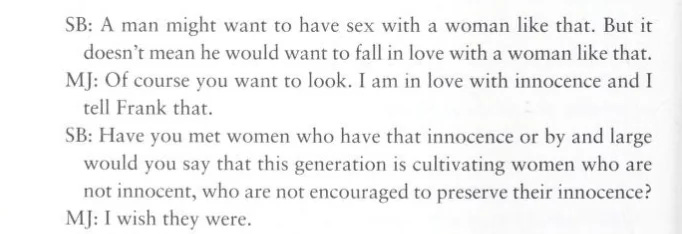
Leaving Neverland Too Quickly
Why do we still feel indebted to Michael Jackson?

“People think his music is great so he is great. And to think that person is doing the worst possible thing to kids is tough for people to wrap their heads around.”
James Safechuck, one of Michael Jackson’s accusers
I saw the Michael Jackson biopic, Michael, both out of a childhood love for his music and a morbid curiosity for how they would depict him in the later half of his life. I loved to dress up like him and practice the dance moves to Thriller in my bedroom in middle school, and always found his story to be one of triumph - this phoenix rising from the ashes of his dad’s brutality to become the King of Pop. Michael Jackson was, in a way, this representation of the new American dream: breaking racial barriers in music and music videos, singing about everyone living in peace and harmony, defying the odds to curate some of the most iconoclastic imagery, outfits, and dance moves of the 80s and 90s while holding a can of Pepsi in his gloved hand.
There is a mysticism and adoration that surrounds Michael Jackson’s unabashed weirdness, an international acceptance of him being uncouth. Between a love for all of his smash hits and a deep empathy for a man who was never allowed to be a child, I feel the world has ultimately taken Michael’s side. And if the general public or mass media does accept his wrongdoing, it’s through jokes and caricatures - Scary Movie, South Park, SNL, Dave Chapelle, The Office. Even when someone can accept the victim testimonies, sit through Leaving Neverland and believe the stories of the traumatized accusers who, in the words of James Safechuck are “little kids who got older, even if people look at us and see grown-ups”, fans find a way to pathologize Jackson’s perversions, explain away pedophilia with therapy-speak. Growing up and hearing those jokes on TV and in the movies my older brother watched led me to ask my mum if the singer I adored truly was a bad man. Having lived through his prime years and owning three copies of This Is It on DVD, my mother struggled to explain that he was a strange man, a troubled man, a boy in the body of a man. Like Peter Pan, he never grew up. And that is a nice, fairytale way to frame his behaviour, but if he didn’t write Thriller and rejoice that We Are The World, how would we explain what he did to those kids?
So this is what I mean when I say that our unanimous collective subconscious when it comes to Michael Jackson is that of pity and adoration. He is our little king of pop, our Peter Pan, our man in the mirror. He never got to be a child. He just got along better with animals and children. Physically he was in his thirties but mentally he was seven. And then we hear grown men - at least four that I’ve counted on record and testimony - come out and say, “This man who wouldn’t harm a fly harmed me for years, sexually, repeatedly, and maliciously,” how do we not immediately pivot the pity we feel for Michael to his victims? Our obsession with him not getting to have a childhood shifting to anger over him taking the childhoods of these boys? Why is that not what happened in this case?
A week after watching Michael, I watched Leaving Neverland, which is a great double feature if you want to feel suicidal and spiritually hungover. Friends of mine raved about the horrifying two part docuseries that is Leaving Neverland during the pandemic - it was Leaving Neverland, Tiger King, and Normal People on our television screens in 2020 and for some reason we were all depressed and paranoid! I never got around to watching Leaving Neverland because it felt too soon. Even if it was a decade ago, it felt like Michael Jackson had just died, and it also felt like I didn’t want to face the fact that he was one of the worst things a person could be. Finding out someone you admire, look up to, glamorize, and deify for decades is someone who was actively causing harm to very vulnerable individuals is an extremely tough pill to swallow.
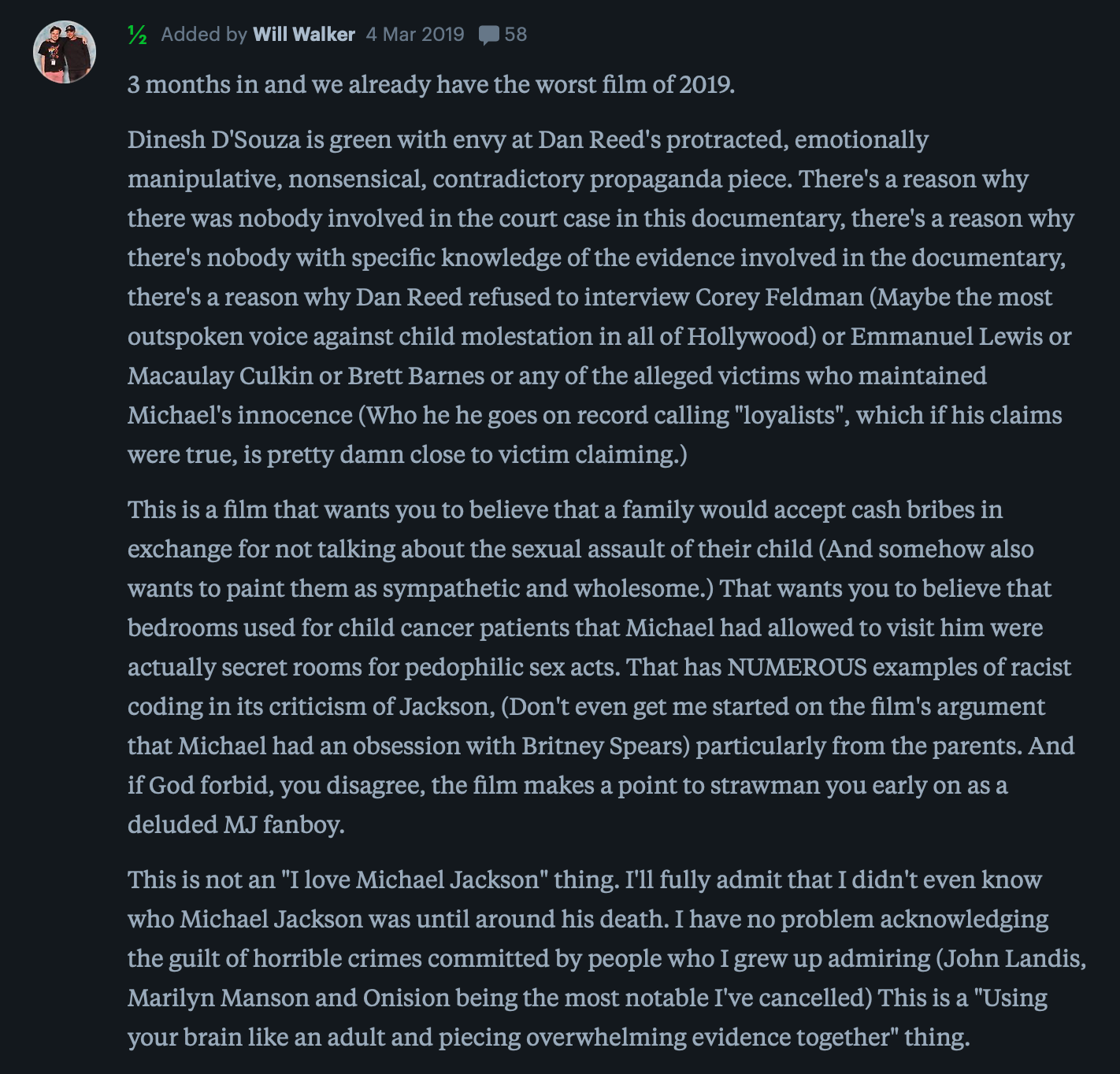
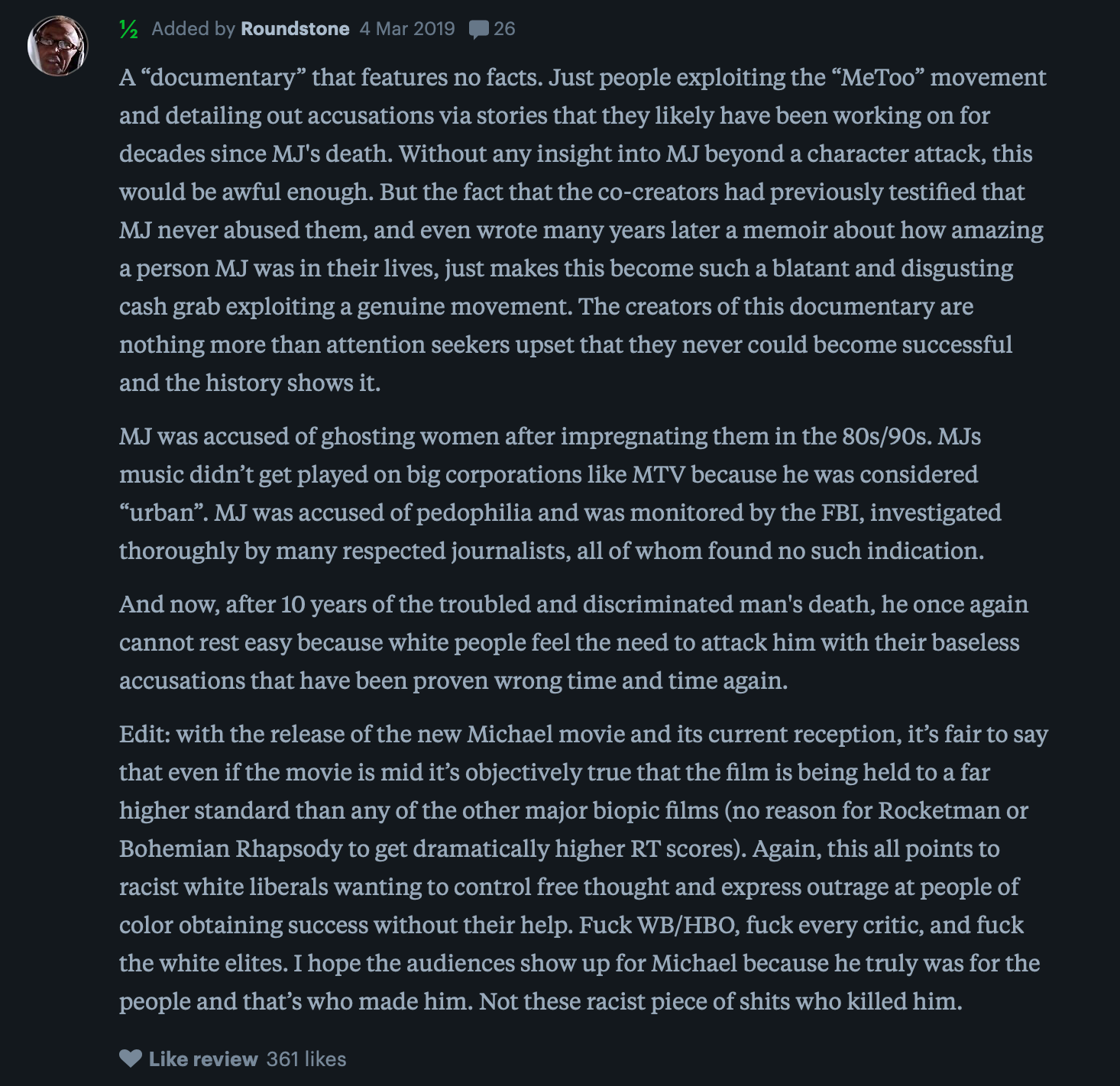
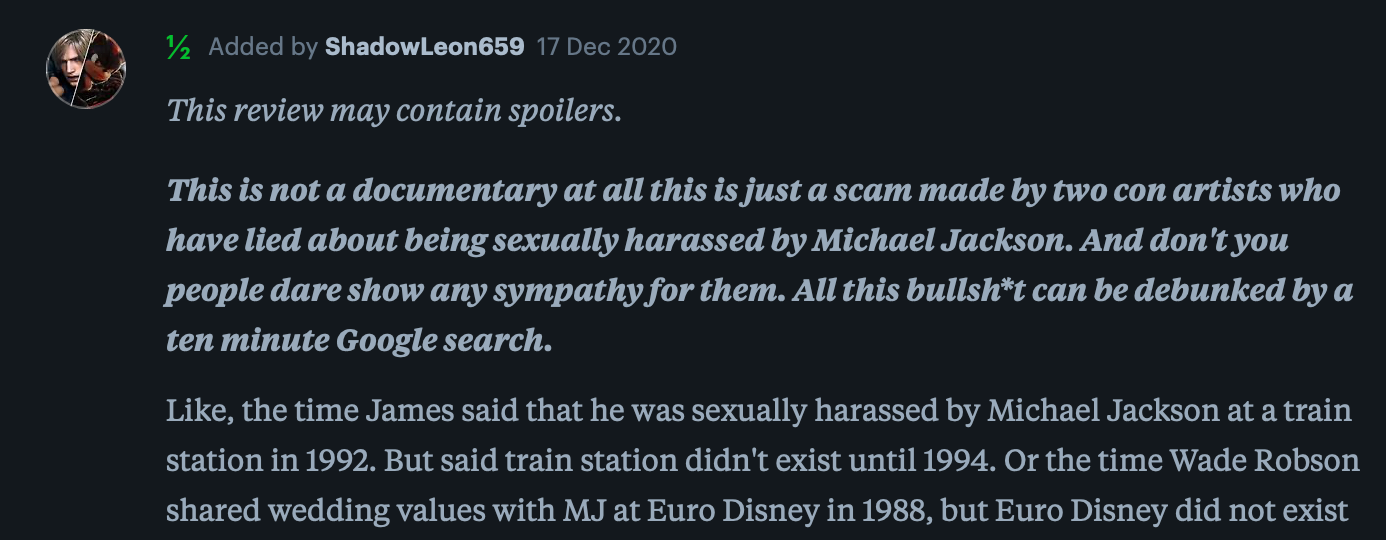
That doesn’t mean it should be an impossible pill to swallow, but if you look at the Letterboxd reviews for Leaving Neverland, you will see that there are many people who do not believe a single word the victims say.
“I can hear him saying to me: I would never hurt a child.”
Accuser Wade’s Robson’s mother on a conversation she had with Jackson
“It’s common for this type of trauma to register later in life. When you’re that small, and you’re that hurt, you don’t even understand what’s happened to you.”
James Safechuck’s wife
“Traumatic events might be more susceptible to memory distortion than benign events because they typically provide more avenues for mental imagery, which can make source monitoring more difficult, and thus source monitoring errors more likely to occur.”
So, what exactly is being alleged, what happened, and why do people think the victims are lying? Michael Jackson has faced two child sexual abuse allegations on record that went to court - one in 1993, and one a decade later in 2003 (trial in 2005). The 1993 case resulted in a multi-million-dollar settlement for the family of the victim, Jordan Chandler, and a new air of mistrust surrounding Jackson grew, but he managed to earn back his reputation by looking at the Man In The Mirror, or at least saying he would through song. In 2005, with Johnny Cochrane as his lawyer, he was found not guilty after Gavin Arvizo’s widely publicized trial. People were on Michael’s side once again. Well, some people. Yes, there were still jokes made and outlandish rumours spread, and even some of the jurors doubted their final decision, but, as we know, the rest is (a very complicated) history.
“It brings tears to my eyes when I see any child who suffers” Michael says with a blank face, reading off of a teleprompter. “I am not guilty of these allegations, but if I am guilty of anything, it is of giving all that I have to give to help children around the world. It is of loving children of all ages and races. It is of gaining sheer joy of seeing children with their innocent and smiling faces.”
Jackson’s statement after Neverland was searched in 2003
“I feel that Michael Jackson probably has molested boys. I cannot believe that, after some of the testimony that was offered, I can't believe that this man could sleep in the same bedroom for 365 straight days and not do something more than watch television and eat popcorn. That doesn't make sense to me. But that doesn't make him guilty of the charges that were presented in this case, and that's where we had to make our decision.”
A juror’s afterthoughts from the 2005 trial
There were other allegations that were dealt with out of court - Jason Francia’s mother settling in 1996, and of course, the posthumous allegations from Wade Robson and James Safechuck explored in Leaving Neverland. Police showed up to Wade Robson’s house after police arrested Micheal Jackson in the 2000s, and Robson said Jackson was innocent.
“Without blinking, without batting an eyelash, without flinching, my answer was no, absolutely not [had he ever touched me], never.”
He would later relay that since all he had ever known was this “special relationship” with Michael, he didn’t think it was anything that could ever be seen as bad. To add fuel to the fire, Michael told Wade after raping him for the first time, “If anyone ever found out that we were doing any of these things, you and I will go to jail for the rest of our lives.” That is an extremely scary thing to be told as a child, and having children defend Michael did not help the cases of current victims. Even the director of Michael, Antoine Fuque, denies the allegations:
“When I hear things about us – Black people in particular, especially in a certain position – there’s always pause,” said Fuqua, before suggesting a double standard was in play by mentioning that Elvis Presley met his future wife, Priscilla, when she was 14.
The director further questioned the motives behind some of the allegations, and added: “sometimes people do some nasty things for some money”. Reed rebutted his remark, calling Fuqua “someone who’s made tens of millions pushing a false narrative around a man who’s a paedophile, that’s a nasty thing.”
When I read that quote, I come to the conclusion that we are simply talking about two pedophiles instead of one, but I digress. Michael Jackson objectively paved ways for marginalized communities, black representation in music and on television, and was extremely generous when it came to fans, charities, and benefit concerts/efforts. People can contain multitudes: you can be a great musician and a bad person. In Michael’s case, you can love every person no matter their race, background, or age, and you can also take that love too far. The narrative that he was a lonely child who lived out his fantasy of being a child is ignorant and quite naive. Understanding why someone sexually abuses children is not something that can be explained away with a single solution or some tortured artist Peter Pan fantasy.
There are many driving factors when it comes to why child abusers and pedophiles do what they do, or at least why they follow through with their perversions and power trips. The first reason is desire: wanting to regain some form of control after missing out on it in life, managing difficult emotions and traumas, wanting to feel loved, and the desire to feel close to someone. “Most child abusers are not only sexually interested in children. Children are often targeted for sexual abuse because they are usually more vulnerable than adults.” I believe this driver best fits what I know about Jackson’s acts, but other forces like delusions (not believing the abuse is actually harming anyone, thinking attraction to children is a normal form of sexuality) and psychological difficulties when it comes to controlling emotions and intimate urges are also drivers that fit Jackson’s recorded history of abuse. “He also protected them in a way that reflected his own lost childhood, and his paranoia about being taken advantage of.”
“There’s zero insight into what makes Jackson tick. He’s this asexual plastic action doll of a figure in the film. And of course, the issue of his relationship with children is completely distorted by the fact that they portray him as an eccentric, overgrown child, which we know is not the full story. They’re saying that the reason Jackson liked children is because he’s an angel and just wanted to be nice to children, not that he wanted to have sex with them … Why are they dancing around this? It’s well-known that Jackson spent a long time with small-boy companions, including taking them into his bed at night and locking the door, which is undisputed – and that alone, if someone made a claim, is probably enough to convict him in a court of child sexual abuse – but with Jackson, none of this stuff seems to matter.”
Dan Reed, director of Leaving Neverland, discussing the new film “Michael”
Jackson’s daughter Paris publicly criticised the film’s script months before its release: “A big section of the film panders to a very specific section of my dad’s fandom that still lives in the fantasy.” The fantasy being normalcy - a denial that Joe Jackson’s violent action towards Michael and his brothers during childhood rewired their brains. And Michael possessed some sort of perversion, some small thing that made him tick, where that rewiring really struck a consequently ruinous chord.
Per Psychology Today:
“One of the most insidious impacts of childhood abuse is the internalization of harmful relationship dynamics. Children raised in abusive households often normalize dysfunctional behaviors such as manipulation, control, or emotional volatility. These behaviors can become ingrained in how we interact with others around us, from friends and colleagues to romantic partners.
For many, these patterns will carry into adult relationships, either as perpetrators or as victims.”
A huge reason many people fail to recognize Jackson as a child abuser is because he abused in an extremely uncouth way - it wasn’t a disgusting hidden tunnel with a mattress on the ground where he kept small children, it wasn’t hitting or yelling or punching, it was rarely penetrative rape, it wasn’t withholding shelter or comfort or care. It started as the promise to meet a celebrity who was a big kid at heart, visit his own personal Disney World with your parents’ plane tickets comped, and a slow and steady progression of grooming - pushing the envelope a little further each night to see what The Michael Jackson could do with his stardom, how close he could get to childhood in any way possible. When you are a child, being loved and seen is integral to your sense of self worth - it is at the top of your hierarchy of needs. When you are a child and you are loved and seen by a celebrity you worship, every compliment, every day spent together, every touch means you are special. You were chosen by Michael Jackson.
Per the Australian Institute of Criminology: “Male victims are most likely to be sexually abused by another known person (27.3%), followed by a stranger (18.3%), another male relative (16.4%), an acquaintance or neighbour (16.2%), or a family friend (15.6%). Small proportions were sexually abused by their father or stepfather (5%).” When your idol begins to idolize you, anything that happens once the sun sets seems like another form of adoration. In Leaving Neverland, a victim’s mother is quoted saying: “It’s not weird for a 34 year old man to be around children like that, not when you know Michael. Not when you know that he didn’t have a childhood.”
And that is exactly what the majority of Jackson supporters truly, genuinely believe. Even to this day.
To groom a child, predators first like to identify a victim - maybe it’s a child you often see walking down your street on their way home from school, or maybe a child sent you an audition tape of them dancing, or maybe you saw them enter a Michael Jackson talent competition at the mall. Once you know the victim and gain their trust, you isolate the child and try to fill whatever needs they have - go to the toy store and fill up a cart with no budget, let them pet giraffes and alpacas and chimpanzees, give them permission to stay up until midnight eating candy and drinking soda. Once they have the child where they want them, perhaps at a particular ranch with many hidden rooms, predators begin to desensitize the child to sexual acts and conversations, creating a power imbalance that becomes impossible for them to escape from. This cycle of abuse and control becomes their new normal, and because it started with so many perks, so much fun, an amazing personal friendship with their favourite celebrity, they will do anything to continue to gain your approval and trust. Anything.
“I remember us sitting at dinner, and Paris (his daughter) just wanting her dad’s attention. And he just wasn’t there. And I remember feeling really sad. What if he loses? What if he goes to jail? And this is the last time they see their dad? That made me want to go support Michael even more.”
Victim Wade Robson remembering having dinner with Jackson during the 2005 trial
Even after Robson had left Neverland and started his own life as a choreographer, he still had this deep desire to be Michael’s friend - to gain his approval and admiration. “People-pleasing can be a result of trauma and was recognized by Pete Walker (Walker, 2013) as the fourth type of trauma response, titled “fawn,” alongside fight, flight, and freeze. According to Walker (2013), fawning is the use of people-pleasing to diffuse conflict, to feel more secure in relationships, and to earn the approval of others.”
I am able to see, not from any professional lens but simply from a human perspective, that Wade Robson and James Safechuck are not very talkative people, not very emotional men. In Leaving Neverland, Wade speaks in facts and straightforward anecdotes, relaying traumas like cells on a spreadsheet as a way to almost get through it quicker. James Safechuck seems perpetually anxious, like he will still get in trouble for sharing what happened between him and Michael long after his death. In a way, he did, but by people defending his ghost online, in the press, and in the recording industry.
“I would have panic attacks about things that shouldn’t give you panic attacks. I didn’t like myself and I didn’t know why. When I was in my early 20s I did a lot of substances to help deal with it, and when I got off the substances, that’s when I really noticed that I was anxious all of the time.”
James Safechuck on blocking out his memories of Jackson’s abuse
Michael Jackson’s childhood was stolen from him by a powerful man, Joe Jackson, who he was perpetually terrified of and perpetually scared to disappoint. In his yearning for love and a cure to his loneliness, Michael took his pain and turned it into a much more hidden, much more perverse, and much more degrading version of exactly what his father did. He became the very thing he was afraid of his entire life without even realizing, and once it was too late, he had convinced himself that his intimate and platonic relationships with children and animals were normal because his life was not. That does not make what he did right, if these allegations are true. And I believe the overwhelming amount of testimony and evidence - wedding rings fitted to children’s hands and hiding spots found in Neverland bedrooms and stacks of magazines featuring naked children posthumously recycled from Michael’s estate and a child who was able to draw a birthmark on Jackson’s private area from memory - are enough to make me believe the victims. You are not a bad person if you go see Michael in theatres, and you are not a bad person if you enjoy it. You just need to remember who the man behind the music was for a good portion of his short life, and how his actions meant that several other children just like him could never have childhoods or adulthoods. He tore apart families and vulnerable young minds - this is not about respecting the dead anymore, it is about protecting the living. I choose to believe Wade Robson, James Safechuck, Jordan Chandler, Gavin Arvizo, and the Cascio siblings, along with anybody else who may come forward in the future. Maybe reading something like this would let them know that they won’t be hurt further for talking about what happened to them. In the meantime, you can email your death threats to me at haleyohalloran13@gmail.com.